📑 Heartwise Allies:
Senior Transition Blueprint
Subtitle:A Step-by-Step Guide to Maximizing Home Equity, Avoiding Family Burnout, and Managing the Seniors Downsizing Process with some Clarity and Dignity.
Preparing Your Home for Sale:
Senior Edition plan
(download & print at bottom of page)
It’s time to downsize and move. Lets look at how we can do that with the least hassles, confusion and stress!.
Making the decision to move as we age can be tough but it is going to happen, and having a game plan and a strategy will be really helpful.
Whether you’re a senior homeowner or an adult child helping a loved one, you know moving is more than just boxes and paperwork. With the right planning and support, you can make this transition easier, less costly, and far less stressful—for everyone involved.
We can dive deeper into these following points but let’s keep it simple for this useful outline.
Pro Tip: A little preparation now can save time, money, and heartache down the road!
✔️Why Home Selling Preparation Matters.
First impressions matter to buyers. A well-prepared home sells faster and for a better price and that’s what we want to do. We want to maximize your profits from the sale of your home and being prepared up front can make that happen. And getting things in order isn’t just about boosting value—it’s about reducing stress, making the move manageable, and setting yourself up for a smooth next chapter.
The Golden Rule of Senior Transitions: Its not just the ‘stuff.’ It’s also Mom and/or Dad!
-So. Always practice the consideration of how the, often, many years of living in a home and collecting memories over all those years affects us as we get older and downsize.
NEXT: ➡️ "The biggest mistake families make is trying to clear the house before understanding the value of some assets. You may be really missing out on some money! Take a deep breath. Stop packing boxes and look at the big picture."
As the aging senior whose moving, you may have the best opinions of your assets value but if you’re the adult child, you are juggling a full-time career, possibly your own kids, and the immense emotional weight of helping your parents’ transition. You want them to be safe, you want them respected, and you want to ensure their hard-earned home equity isn't wasted.
This blueprint divides the monumental task of downsizing into four manageable phases so you can preserve your sanity and protect their financial legacy.
📍 Phase 1: The Visual Allocation Strategy (The Sticker System)
Before you hire a single mover or dumpster, you must categorize the estate.
Walk through the home room-by-room (starting with high-density areas like the garage, workshop, or basement) and use a simple, visual Three-Sticker System:
🟢 Green Sticker (Take With Us): Sentimental items, immediate daily clothing, essential furniture, and high-value legacy pieces meant for the next residence.
🔵 Blue Sticker (Private/Local Sale): High-value assets that can be converted into fast liquidity (e.g., specialized shop tools, heavy machinery, high-end furniture).
🟣 Purple Sticker (Estate Auction): Items that hold value but are better suited for broader market competition or professional liquidation networks.
🔴 Red Sticker (Apprentice Gift / Donation): Functional items that can be gifted directly to young tradespeople entering the field, or donated to local community groups.
🟡Yellow Sticker (Donations): Anything you want to give away for family, friends or causes.
🛠️ Phase 2: Preserving the Tradesman Legacy (The Tool Inventory)
If your parents have a workshop or a lifetime collection of high-quality tools (like specialized plumbing, woodworking, or mechanical gear), do not let a standard estate liquidator batch-sell them for pennies on the dollar.
Audit the Assets: Separate precision power tools, vintage hand tools, and heavy machinery.
The Transition Capital Engine: High-end trade tools represent significant hidden capital. Properly itemizing and valuing these assets can directly fund the transition, senior placement deposits, or moving costs.
The Apprentice Legacy: For tools that won’t be sold, consider directing them to local trade apprentices. It gives your parent immense pride to know their lifetime of craftsmanship is being passed down to the next generation, making the emotional parting much easier.
🏡 Phase 3: The Strategic Real Estate Checklist
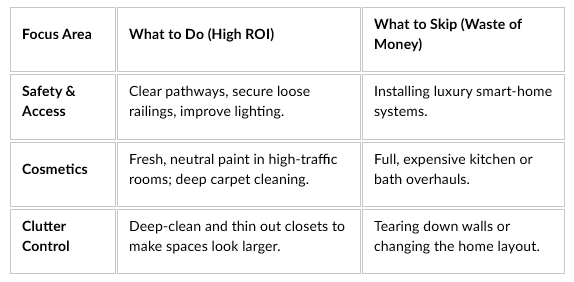
You do not need to spend tens of thousands of dollars remodeling the family home to sell it for top dollar!
Focus exclusively on fixes that provide a guaranteed return on investment (): Your Real Estate Broker should have the wisdom and experience to help you determine your Seniors home value and selling opportunity. (the basics below)
1️⃣Step 1: De-cluttering and Downsizing
Benefits: A de-cluttered home feels bigger, brighter, and more welcoming. It also means less to move or pack later!
How to start: Go room by room. Sort items into these categories: keep, donate, give to family, sell, or toss. Be honest—what do you use and treasure?
Sentimental items? Take photos, or pass them to loved ones who will cherish them. You’re not losing memories—you’re making space for new ones.
Get help: Invite family, or hire a professional organizer or estate sale team. An outsider’s perspective often makes decisions (and heavy lifting) easier.
Advice for Adult Children:
Be patient and empathetic! And take it easy on yourself…De-cluttering isn’t just about “stuff”
—it’s about honoring years of memories.
2️⃣Step 2: Cleaning and Repairs
Deep clean: Focus on kitchens, bathrooms, carpets, and windows. A sparkling home says “well cared for.”
Easy fixes: Dripping faucets, squeaky doors, chipped paint—small problems can make buyers worry about big ones.
Safety first: Clear walkways, secure rugs, check handrails. A safe home welcomes everyone, especially other seniors or families with children.
Can’t do it all? Hire local cleaning or handyman services. The investment pays off in peace of mind and buyer appeal.
3️⃣Step 3: Staging and Highlighting Senior-Friendly Features
Staging basics: Neutral décor, bright lights, open spaces. Less is more!
Show off accessibility: If you have grab bars, ramps, or a first-floor bedroom, highlight them. These features are a plus for other seniors and multi-generational buyers.
Affordable upgrades: Sometimes just rearranging furniture, adding fresh flowers, or a cozy throw blanket makes a big impact.
4️⃣Step 4: Curb Appeal—Don’t Forget the Outside!
Tidy up: Trim bushes, mow the lawn, plant flowers.
Welcoming entry: Fresh paint on the door or new house numbers can make your home stand out.
First impressions: Buyers judge your home from the sidewalk, so make it shine!
⏳ Phase 4: Timelines & The Equity Bridge
Managing the timeline is where most adult children burn out. They try to do everything over a single, exhausting weekend. Instead, use the 60-Day Staged Timeline:
Days 1–15: Complete the room-by-room visual allocation (Sticker Phase).
Days 16–30: Inventory the high-value assets and workshop items to calculate total estimated transition capital.
Days 31–45: Secure senior placement or the new residence using the estimated equity as your financial baseline.
Days 46–60: Execute the move of the 🟢 (Green) items first, allowing your parents to settle safely into their new home before the house is prepared for market.
📞 Back Page / Call to Action: Let Us Carry the Heavy Lifting
"You shouldn't have to choose between being a manager and being a supportive son or daughter."
Navigating senior placements, itemizing decades of assets, and balancing real estate logistics in King County is a full-time job. That’s what I do, bridging the gap between real estate, senior transition planning, and asset valuation.
Ready to build your custom family roadmap?
Call us directly at 425.894.4316 or schedule a 20 minute Free Gentle Transition Strategy Call.
Visit us at HeartWiseAllies.com
Jeremy Hickling / CSA® . CAPS . CNA
Certified Senior Advisor & Senior Transition Advisor
📞 425.894.4316 / 🌐 Jeremy@HeartWiseAllies.com
Getting past planning and beginning to see how the plan will work and then finally executing the plan feels terrific. Paralysis by analysis can really stop people from making progress and we hope this tool is helpful - change it in any way you need to but use a system like this and start using it now. Procrastination can really be your worst enemy!